
Shalini Badola and Clément Faugeras, LNCMI Grenoble
Excitons in two-dimensional semiconductors, photogenerated electron-hole pairs, are directly exposed to their environment and are sensitive to the dielectric properties of their surrounding. The dielectric screening from the environment modifies the energy spacing between the exciton excited states and variations of the dielectric properties induce changes in exciton Rydberg series. This property makes them ideal candidates for quantum sensing of the dielectric properties.
Here, we show that the Rydberg series of excited states of excitons in a monolayer WSe2 encapsulated in hexagonal boron nitride (hBN) can be used to probe the pressure-induced modifications of the surrounding dielectric properties. We have assembled on the diamond of a diamond anvil cell a van der Waals heterostructure composed of hBN/ML WSe2/hBN. By measuring the pressure evolution of the photoluminescence of excitons and of their excited states, we evidenced changes in the Rydberg series, see Fig 1. We propose a model based on the pressure induced evolution of the interlayer distances in this van der Waals heterostructure and on the bulk dielectric properties of hBN. This approach allows a direct measurement of the dielectric constant of pressurized hBN and establishes a new methodology for dielectric sensing. Beyond the specific case of hBN/WSe2/hBN heterostructures, our results highlight the broader potential of excitons in two-dimensional semiconductors as quantum sensors of their electrostatic environment. This methodology can be readily extended to other layered materials, heterostructure geometries, and external stimuli, providing a general framework for Coulomb engineering and dielectric metrology in low-dimensional systems. Our approach establishes excitons in 2D semiconductors as versatile quantum sensors for dielectric properties under extreme conditions, with potential applications in Coulomb engineering and the design of optoelectronic devices.
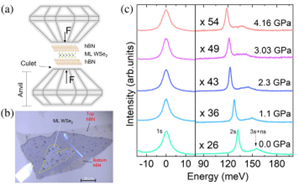
Figure caption: a) Schematic of the experiment showing the diamond anvil cell with the vdW heterostructure exfoliated and transferred on the culet. The WSe2 ML is indicated with the yellow dashed line. (b) Optical image of the vdW heterostructure on the culet. (c) Pressure evolution of the photoluminescence for the encapsulated WSe2 monolayer showing the modifications of the exciton Rydberg series. Spectra are shifted in energy to the 1s state energy for each pressure and normalized with respect to the 1s state intensity, and the excited states are scaled with the factor indicated for each pressure. ns denotes exciton excited states with principal quantum number higher than 3.
Publication: S. Badola et al., Physical Review Letters 137, 036903 (2026); https://doi.org/10.1103/245v-mgsb
Contact: C. Faugeras clement.faugeras@lncmi.cnrs.fr