
Force magnétostatique et haute température
« Magnéto-Science », désigne l’étude des effets des champs magnétiques sur les procédés physique, chimiques et biologiques. Il s’agit d’exploiter les effets des forces et couples magnéto-statique, des couplages électro-magnétiques et de l’énergie magnéto-statique, de l’échelle macroscopique à l’échelle atomique.
A l’échelle macroscopique, on exploite la force magnéto-statique pour simuler la micro-gravité et réaliser en laboratoire des expériences autrement réalisées dans des tours à chute libre ou dans l’espace. Ces mêmes forces peuvent également contrôler la convection dans les fluides où les propriétés magnétiques dépendent de la température.
A l’échelle microscopique, les couplages magnétiques et électromagnétiques jouent un rôle important en élaboration des matériaux : il est possible de contrôler la texture cristalline, de modifier la forme des cristaux, des dendrites…
A l’échelle atomique, on observe dans certains systèmes (par exemple les aciers) un effet important sur les températures d’équilibre thermo-dynamique : on dispose ainsi d’un nouveau levier, qui s’ajoute aux traitements thermiques et mécaniques conventionnels, pour trouver de nouvelles voies d’élaboration de matériaux.
Certains effets sont très bien connus, et permettent d’inventer de nouvelles conditions expérimentales, par exemple en micro-gravité simulée.
D’autres sont encore à explorer comme l’effet sur la diffusion atomique, effet observé dans plusieurs systèmes métallurgiques, avec des ré
Membres de l’équipe

Thèmes

Magnetic levitation
The magnetic levitation is the application of a bulk force that compensates the gravity on every part of a sample. This environment is very similar to free fall such as in drop tube or experiments in orbiting stations.
If the material is diamagnetic, such as water and organic materials, it is even possible to maintain a stable contactless environment for long run experiments (hours) at reduced costs. The magnetic levitation of water was hence demonstrated for the first time in 1991 (E.Beaugnon, R. Tournier, Levitation of organic materials, Nature 349 (6309), 134-136).
An example of such experiments is the recent measurement of free levitating water droplets oscillations (see figure on the left). A droplet is excited by an acoustic wave, resonant modes are explored, and once obtained, the acoustic wave is removed and the droplet freely oscillate. The frequency of the oscillation gives the surface tension, and the decaying of the amplitude gives the viscosity.
Magnetization at high temperature
The magnetization M of a sample can be very precisely determined by measuring the magnetic force acting on it. Such measurements are performed during solid state heat treatments and solidification processes of metals at high temperature.
This measurement allows the precise in situ monitoring of phases evolution and transformation. We have studied pure Cobalt, Co-Sn and Co-B near eutectic alloys. In the first case, we have determined that liquid undercooled Cobalt is more magnetic than solid Cobalt at the same temperature, which is contradictory with the liquid expansion and lesser Co to Co magnetic interactions. In the Co-B and Co-Sn ear eutectic alloys, we have observed for the first time a liquid to liquid phase transition at high temperature. On the left picture, an example is given for hypoeutectic CoSn (Jun Wang, Jinshan Li, Rui Hu, Hongchao Kou, Eric Beaugnon, Evidence for the structure transition in a liquid Co–Sn alloy by in-situ magnetization measurement, Materials Letters 145 (2015), 261). The red curve is the heating curve. The linear part corresponds to paramagnetic Curie Weiss law of 1/M versus T for the first liquid alloy L1 (melting is slightly above 1100 °C). Above T0, the slope of 1/M is obviously changed, revealing a new liquid structure L2 that is maintained on cooling (blue curve) until solidification (below 900°C in an undercooled state).

Techniques
High temperature magnetometer
High temperature furnaces (up to 1550 °C) can be inserted inside superconducting magnets and high field resistive magnets at LNCMI. In the case of superconducting magnets, where long term experiments even for several days can be performed, in situ magnetic measurements have been added.
The heating element is a SiC heater, covered by an insulating refractory material. The furnace is cooled by a water jacket. The sample is positioned above the maximum field on the vertical axis of the magnet, where a downward magnetic force exists for ferromagnetic and paramagnetic materials.
The experiments are realized without vacuum or inert gas, but the solid or liquid metal is protected by a flux glass.
The magnetic force is measured by an electronic scale away from the magnetic field of the magnet. Both magnetic force (from which the magnetization M is calculated) and sample and furnace temperatures are continuously recorded.

Stable diamagnetic levitation and in situ measurements
Stable diamagnetic levitation can be performed in both a superconducting magnet (32 mm available bore, or 26 mm with controlled temperature) or a resistive high field magnet with a 50 mm bore.
In these devices, diamagnetic liquids such as water can be levitated, without any contact with the magnet bore and without requiring any container.
We have developed several in situ devices to provide in situ, real-time, monitoring of the sample levitation:
- Video recording with a regular camera far from the magnet and with a zooming lens. High speed video up to 1000 frames per second could be recorded.
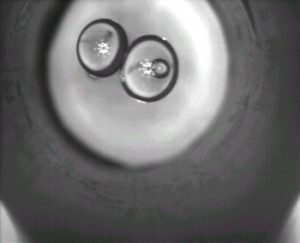
- Video with in situ camera inserted in the maximum field. Successful experiments were performed and improved image quality tiny cameras are under progress.
- Liquid drop oscillation accurate measurements. We use a confocal sensor to monitor the distance of a free surface, and then the vibration modes of a magnetically levitated liquid droplet.

Publications
Publications selectionnées
E.Beaugnon, R. Tournier
Levitation of organic materials
D Braithwaite, E Beaugnon, R Tournier
Magnetically controlled convection in a paramagnetic fluid
Jun Wang, Jinshan Li, Rui Hu, Hongchao Kou, Eric Beaugnon
Evidence for the structure transition in a liquid Co–Sn alloy by in-situ magnetization measurement
Materials Letters 145, 261 (2015)
Jun Wang, Jinshan Li, Rui Hu, Hongchao Kou, Eric Beaugnon
Anomalous magnetism and normal field instability in supercooled liquid cobalt
Appl. Phys. Lett. 105, 144101 (2014)
G Diguet, E Beaugnon, JY Cavaillé
Shape effect in the magnetostriction of ferromagnetic composite
Journal of Magnetism and Magnetic Materials 322,21, 3337-3341 (2010)
E Beaugnon
3D physical modeling of anisotropic grain growth at high temperature in local strong magnetic force field
Science and Technology of Advanced Materials 9 (2), 024201 (2008)
Publications LNCMI de la thématique sur HAL